zero-point/null-point: Marcelo Guarnieri Gallery, São Paulo (2021).
[english transcript of the video on the right]:
tweet from @sanguecorsario: watching Schindler’s List with my parents when I was very young left a strange, unsettling mark on me. For a while, I genuinely believed that color itself was a recent invention in human history.
We often state without much hesitation that primitive man invented fire. We explain this by saying that man took a probable chance occurrence, a tree struck by lightning, as a model. But how is it possible that man recognized in the model of the burning tree the potential to cook meat, and thus became a hunter? In other words, how is it possible that a probable chance event, a tree on fire, was transformed into an extremely improbable chance event, a carnivorous primate?
We speculate that the first colors named in all cultures are simultaneously contrasting: black and white, deep emptiness and absolute luminosity. Next, cultures may diverge between red and its variations of yellow and green. Blue, however, has always been the last color to be named. The daytime sky is sometimes blue, as are other hues throughout the day, and although it has been above us since birth, its light did not inspire us to define a color.
This raises the possibility that the category [blue color] emerged through technology. If black emerged from coal, white from milk and lard, red from clay, and yellow from grains and honey then blue was the last to emerge because maybe it might’ve required at least some sophisticated mining techniques.
Only then would we name and know it.
On the other hand, we now know that the brain is not always assimilating all and any information from outside - that is, from the sensory apparatus into consciousness. It is, in fact, filtering what it knows from what it does not know and calibrating the world according to its categories and according to the predictions it is able to make, mentally, in each new situation.
Contrarily, the mind surrounded by machines is sheltered, and therefore safe, from nature, because it has decided to consume it. In order to devour nature, it had to be cut into slices. The knife that cuts Nature into slices is called specialization, and its duty is to sever the multiple connections that unifies Nature and transform these severed connections into devices.
Nature, if amputated and ready to be consumed, lost its chaotic aspect through this operation and became orderly. From the height of nature's order emerged devices that were supposed to compute coincidences so quickly that the desired coincidence would occur not in astronomical time, but in humanly usable time, in a single instant.
To reconnect these severed coincidences, one needs computation and automation. Automation means rapid computation of coincidences. A blind junction to the flow of controlled chance. Thus, programming means stopping automation at the precise moment when the desired coincidence occurs. Human decision, human freedom, is therefore the ability to make the automatic device stop operating at a desired chance.
The initial apparatuses obeyed programs determined by various human desires. These initial devices gave rise to successive generations of apparatuses in which the initial desire became diluted. The further this process advances, the more human desire is diluted in them, until desire evaporates completely.
So we see this entropic tendency, towards the singularity of all programs, a single mode of cosmic totalitarianism where the metaprogram programs itself automatically. Because the will of the metaprogram is entropic it tends toward a catastrophic coalition that ultimately dissolves [our desires and] ourselves.
That burning tree that led our ancestors to cook their food culminates in a scenario in which science and technology have destroyed the solidity of the world for us, only to then recompose everything in the form of an imagistic and imaginary aura of apparent surfaces, that is, technical images formed through the accumulation of endless beams of points in terminals. These images establish themselves in the world and slowly replace it. What characterizes the current cultural revolution is precisely the fact that participants inside our culture ignore the inner workings of the black boxes that run computers, digital cameras, cell phones and the internet.
This current cultural situation eliminates learning and is content with the programming of its participants.
Contempt for the technology that underpins the new cultural situation is embedded in the programming of these devices. The information society is controlled by central emitters, strategic offices that process data randomly, quickly and in enormous quantities, producing calculations filtered by critics and sensors according to quantitative criteria. The human mind, on the other hand, is driven by the machinery of thoughts, desires, and experiences scattered throughout the mind.
Humankind suddenly finds itself eliminated from the creative process, reduced to consuming all the information produced by the program and represented by a particular collection of data.
Within societies themselves, there is nothing but the vacuities called selfs, in which data, transformed into images, is computed and calculated. It is precisely the extrapolation of technical work that allowed our ancestors to perceive the blue color of nature, which also replaces men with automatons in the creative process, both in its productive, critical and decision-making capacities. The flow of automatically generated information floods the selfs, those voids in which information intersects to be consumed, that is, forgotten.
Individual consciousness, from which reality emerges, is the zero point of experience. It often clashes with its surroundings and reacts by protecting itself from the overabundance of stimuli.
The synesthetic system begins to repel excesses in order to protect the body from accidents and the psyche from the trauma of shock, thus reversing its role. From synesthetic, the sensory system becomes anesthetic. Under extreme stress, consciousness begins to work as a shock absorber that reduces the openness of the synesthetic system and thus isolates the subject from their past memory.
Without the depth of memory, experience is impoverished. Isolated from experience, memory is replaced by conditioned response. Learning is replaced by exercise, skill by repetition.
From zero point, consciousness moves to null point. The probabilistic study implemented by the program within the apparatus results in the prediction of possible trends. Trends advance to a certain limit point, called catastrophe and then changes its course.
Catastrophes can arise from the trend itself, or come from outside.
All prophecy necessarily disregards catastrophes because they are unpredictable, but aims to avoid them. In short, projecting the trend is forecasting, while substantivizing change is prophesying.
If we cannot plan for the future, every new event becomes a catastrophe. The fact is that in the future we will no longer have to make decisions, because the best choice will be anticipated by the program at the speed of events themselves. We retain, however, the right to revoke decisions made automatically, the right to say no, to veto, so that we will cease to be censors, but will continue to be tribunes.
To be good tribunes, we will need to reestablish libidinous intimacy with a new aesthetic. An aesthetic that is capable of emancipating us from the intended program.
[-] installation views: both videos played, side by side, in a continuous loop.
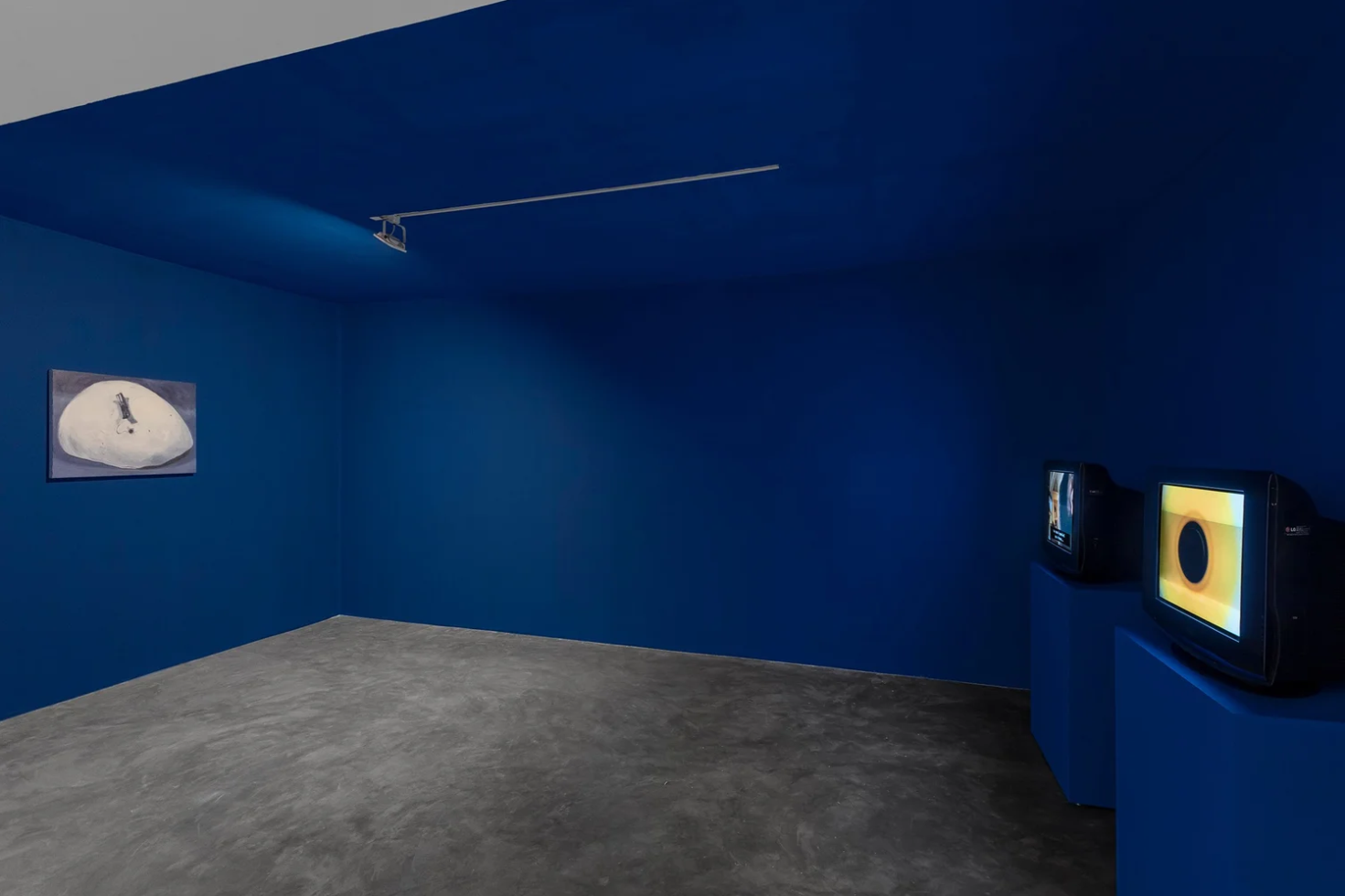
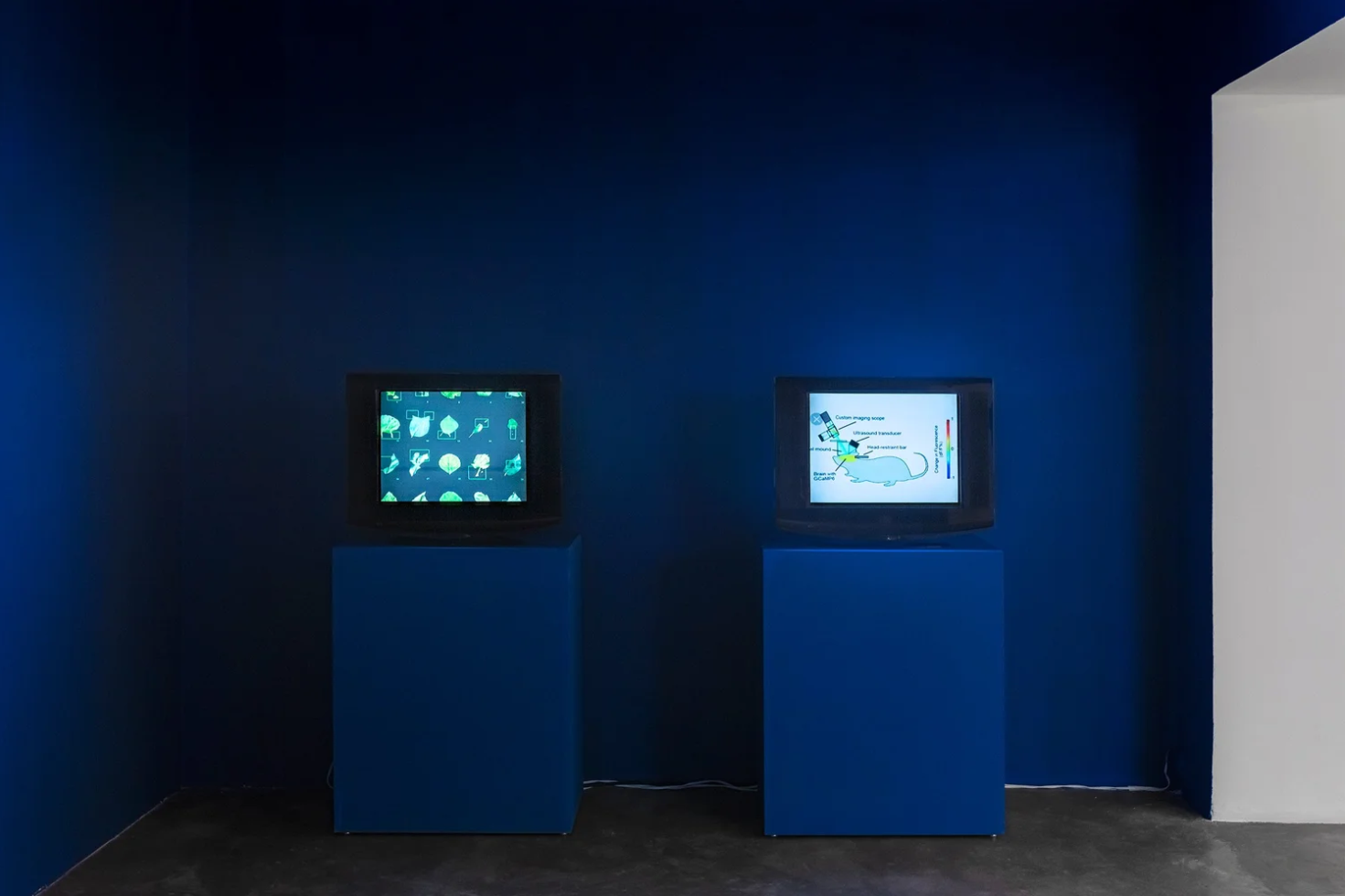
left: collection of media from the artist’s research folder in alphabetical order.
right: speculations and notes on Vilém Flusser’s Into the Universe of Technical Images interspersed with memes and images found during the process of reading and note-taking.
note 1: The use of a heavily synthetic voice in the video narration is intentional. The original vocal texture and pitch came from a standardized masculine tone engineered to sound lifelike, almost organic. The subsequent audio processing was designed to evoke early-1980s speech-synthesis systems (such as the TMS5220, Votrax SC-01 and DECtalk), creating a tonal bridge between the era in which Flusser wrote the text and the present moment.
note 11: the images and memes presented deliberately lack context and have been organized as a more fragile version of a Warburgian Mnemosyne Atlas, in linear video form.